
How Hospitals Should Choose an ICU Bed: Start With Clinical Workflow, Not the Feature List
Choosing an ICU bed should begin with patient-care workflow, positioning needs, nursing access, mobility, safety and maintainability—not simply the longest feature list. This opinion explains how hospitals can compare electric, hydraulic and mechanical ICU beds more intelligently.

What to remember
- An ICU bed should be selected around the clinical workflow of the care area, not simply the number of functions advertised.
- Electric, hydraulic and mechanical ICU beds can all be appropriate when matched to the intended patient-care environment.
- Positioning, bed height, side rails, braking, mobility and caregiver access deserve as much attention as headline features.
- Features such as CPR, Trendelenburg and central braking should be specified only when the hospital actually requires them.
- Hospitals should evaluate lifecycle reliability, cleaning, serviceability and spare-parts support alongside the initial purchase price.
Table of contents
- There Is No Single “Best” ICU Bed
- Start With the Clinical Workflow
- 1. Positioning Functions Should Have a Purpose
- 2. Adjustable Height Is More Important Than It First Appears
- 3. Electric Versus Mechanical Is Not Simply Modern Versus Old
- 4. Do Not Ignore the Braking System
- 5. Side Rails Need to Balance Protection and Access
- 6. Think About Emergency Access Before an Emergency Happens
- 7. Nurse Controls Can Matter More Than Another Motor
- 8. Mechanical ICU Beds Still Have a Role
- 9. Consider Imaging and Bedside Equipment
- 10. Dimensions Matter Before the Bed Reaches the ICU
- 11. Cleaning and Infection-Control Practicality Should Be Evaluated Physically
- 12. Purchase Price Is Only One Part of ICU Bed Cost
- A Practical Way to Write an ICU Bed Specification
- My View: The Best ICU Bed Is the One the Hospital Can Use Well
An intensive care unit is one of the few places in a hospital where the bed itself becomes part of the working environment around the patient. Nurses may need access from several sides. Patients may need frequent repositioning. Monitoring equipment, IV lines, oxygen equipment and other devices may be positioned around the bed. At the same time, the bed may need to be moved quickly, cleaned regularly and kept dependable through years of use.
That is why I believe hospitals make a mistake when they select an ICU bed simply by comparing how many functions are printed in a catalogue.
The better question is much more practical: what does this particular critical-care environment actually require the bed to do?
There Is No Single “Best” ICU Bed
ICU beds are often discussed as though there is a simple hierarchy: more motors, more controls and more functions must automatically mean a better bed.
I do not think that is the right way to look at it.
A highly equipped electric ICU bed can make excellent sense in a tertiary hospital where critically ill patients require frequent repositioning, where nursing teams work around the patient continuously and where rapid bed adjustment is part of normal workflow.
But a mechanically operated or partly hydraulic bed may still be the more practical choice in another healthcare environment where electrical dependence needs to be reduced, maintenance resources are limited, or the required patient-positioning functions are simpler.
The right ICU bed is therefore not necessarily the bed with the longest specification sheet. It is the bed whose capabilities match the actual care environment.
Start With the Clinical Workflow
Before discussing motors, rails or control panels, I would first look at how the bed will actually be used.
Will it be installed in a general intensive-care unit, a high-dependency unit, an emergency department, a recovery area or another monitored-care environment? How often will nurses need to change the patient's position? Will the bed regularly be moved between rooms? Does staff need access to the patient's head end during emergency procedures? Will portable imaging be performed around the bed? What other equipment normally occupies the same bed space?
These questions sound basic, but they determine whether many expensive features are genuinely useful.
An ICU procurement specification should follow the workflow rather than forcing the workflow to adapt to equipment that was selected mainly from a brochure.
1. Positioning Functions Should Have a Purpose
Backrest and knee-rest adjustment are common features because changing the patient-support surface can make nursing care and patient positioning more manageable.
More advanced ICU beds may add overall height adjustment, Trendelenburg and Reverse Trendelenburg positioning. Some designs also provide a chair-position function.
These capabilities can be valuable, but procurement teams should resist the temptation to treat every movement as mandatory simply because it exists.
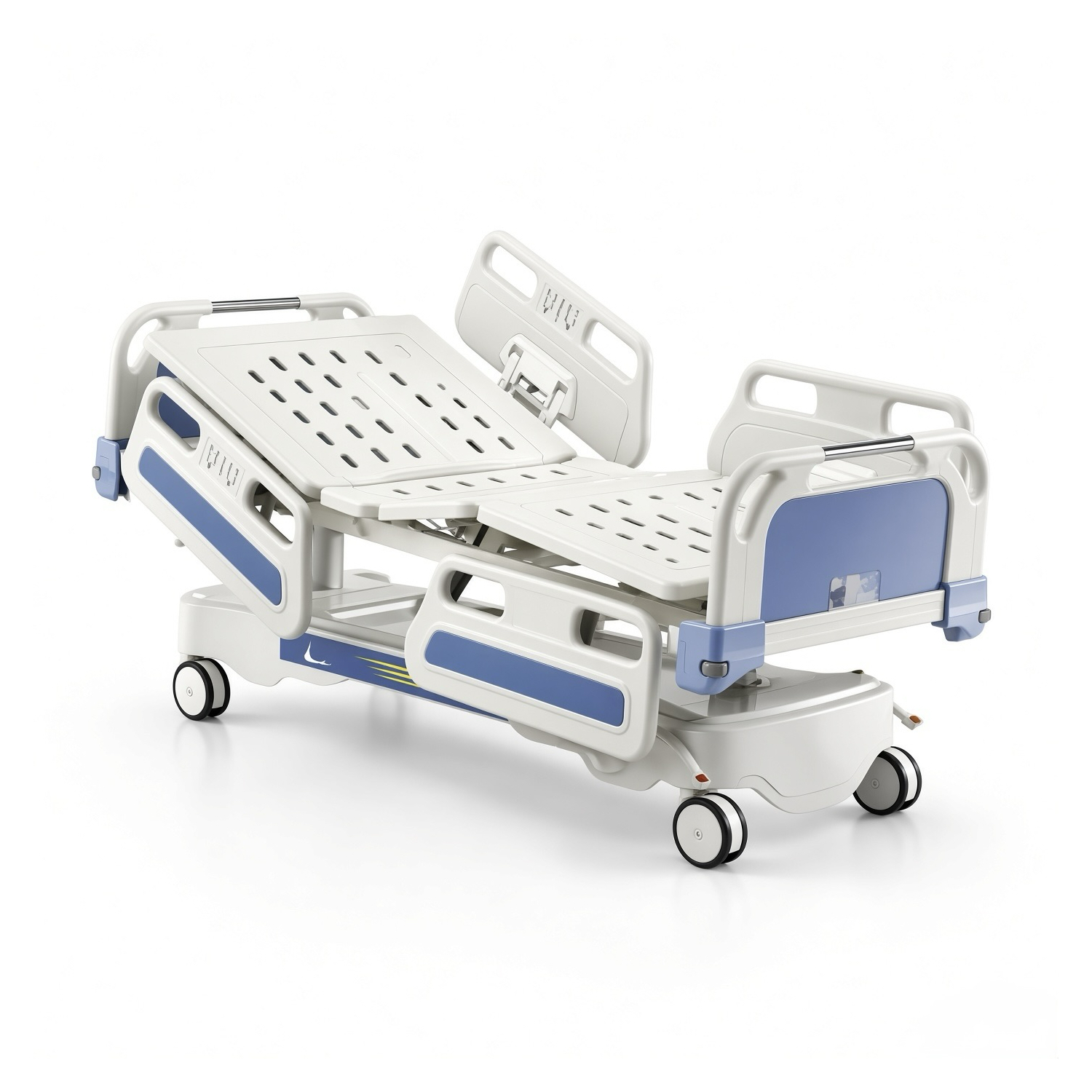
For example, the current IndoSurgicals ICU range demonstrates how different beds can provide very different combinations of backrest adjustment, knee-rest movement, Hi-Lo adjustment and whole-bed tilt. Not every model includes every function. That is a useful reminder that the required movements should be written into the purchasing specification deliberately rather than assumed.
Clinical positioning itself should, of course, always be determined by qualified healthcare professionals according to the patient's condition and the hospital's protocols. A bed provides positioning capability; it does not determine treatment.
2. Adjustable Height Is More Important Than It First Appears
When people compare ICU beds, attention naturally goes to visible features such as electric controls and side rails. Bed height often receives less attention.
In daily nursing work, however, the ability to raise or lower the entire patient platform can have a significant effect on how staff approach bedside care, transfers and routine procedures.
A lower position may also be useful in particular patient-management situations, while a higher working position may improve access for caregivers.
For this reason, procurement teams should look at the actual published minimum and maximum bed height rather than merely checking a box marked “Hi-Lo”.
3. Electric Versus Mechanical Is Not Simply Modern Versus Old
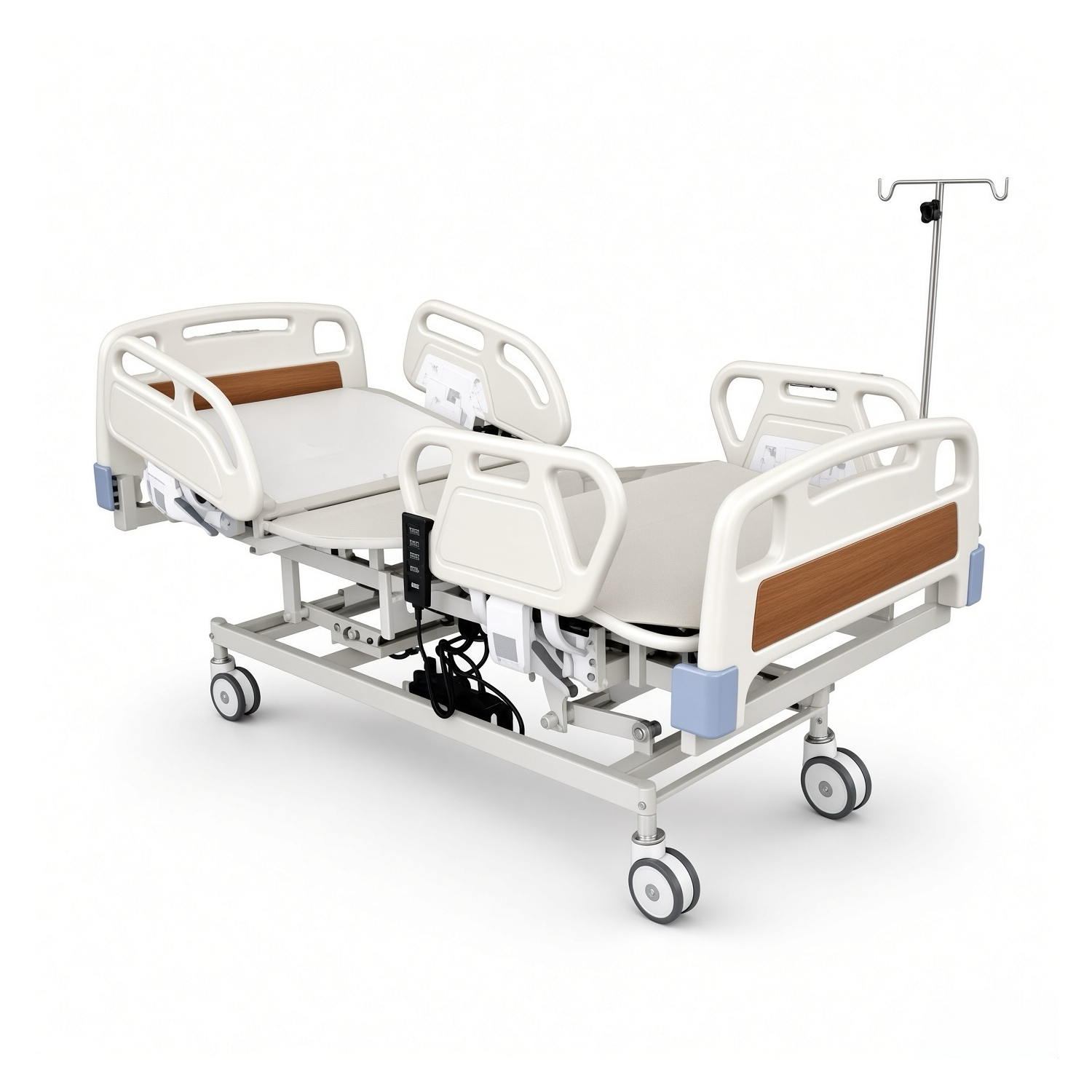
Electric ICU beds offer an obvious advantage: several positioning functions can be operated through powered actuators instead of manual mechanisms.
In a busy ICU, that can simplify repeated adjustments. Certain models may also provide separate patient and caregiver controls, nurse-control panels or emergency functions.
Mechanical beds approach the same problem differently. Backrest, knee-rest, height or tilt functions can be operated with screw mechanisms, cranks or hydraulic systems depending on the design.
That may require more physical interaction from staff, but it can also reduce dependence on motors, electronic controls and continuous power availability.
For me, the important distinction is therefore not “advanced versus basic”. The real issue is operational suitability.
A hospital with strong biomedical-engineering support and a high-acuity ICU may place considerable value on electric adjustment. A facility working in a different environment may deliberately prioritise mechanical simplicity and maintainability.
Both decisions can be rational.
4. Do Not Ignore the Braking System
Brakes rarely receive the same attention as motors, yet the braking arrangement affects everyday handling of the bed.
Some hospital beds use individually braked castors. Other ICU beds incorporate a central braking arrangement that allows the braking system to be controlled as a coordinated system.
Neither description should be treated casually in a tender.
Hospitals should confirm exactly what braking configuration is supplied, how it is operated, how the bed behaves during movement and how easily staff can secure it after repositioning.
Wheel diameter, manoeuvrability and floor conditions also matter. A bed that looks excellent in a product photograph still has to travel through the real corridors, lifts, doorways and clinical spaces of the hospital.
5. Side Rails Need to Balance Protection and Access
ICU beds may use ABS safety rails, stainless-steel tubular rails, aluminium rails or other configurations depending on the model.
The material is only part of the decision.
Hospitals should look at how the rail lowers, whether it moves out of the caregiver's working space, how easy it is to operate, whether the mechanism can be cleaned properly and how the rail interacts with the mattress and patient platform.
Side rails provide a physical boundary, but they should never be considered a complete fall-prevention system by themselves. Their use has to form part of patient assessment and the healthcare facility's wider safety procedures.
6. Think About Emergency Access Before an Emergency Happens
An advanced ICU bed may include a CPR-related release or control function intended to help the bed return to an appropriate configuration during emergency workflow.
This is the kind of feature that should be assessed practically, not just mentioned in the purchase order.
Staff need to know where the control is located, what it actually does, how quickly it operates and how it fits into the hospital's emergency protocol.
Equally important, procurement teams should not assume that every electric ICU bed automatically contains a CPR function. Specifications vary considerably between models.
7. Nurse Controls Can Matter More Than Another Motor
When I compare ICU bed designs, I pay particular attention to who controls the bed and how.
A hand control may provide access to routine electric positioning. More advanced designs may add a nurse-control panel, caregiver interface or other control arrangements.
These controls can affect how conveniently staff manage positioning, but hospitals should verify the actual functions instead of assuming that every nurse panel provides the same buttons, lockouts or control hierarchy.
This is an area where a demonstration before a large purchase can be much more informative than a specification sheet.
8. Mechanical ICU Beds Still Have a Role
The continued availability of mechanically adjustable ICU beds is not an accident.
They can provide backrest, knee-rest, height or tilt adjustment without relying entirely on an electrical actuator system.
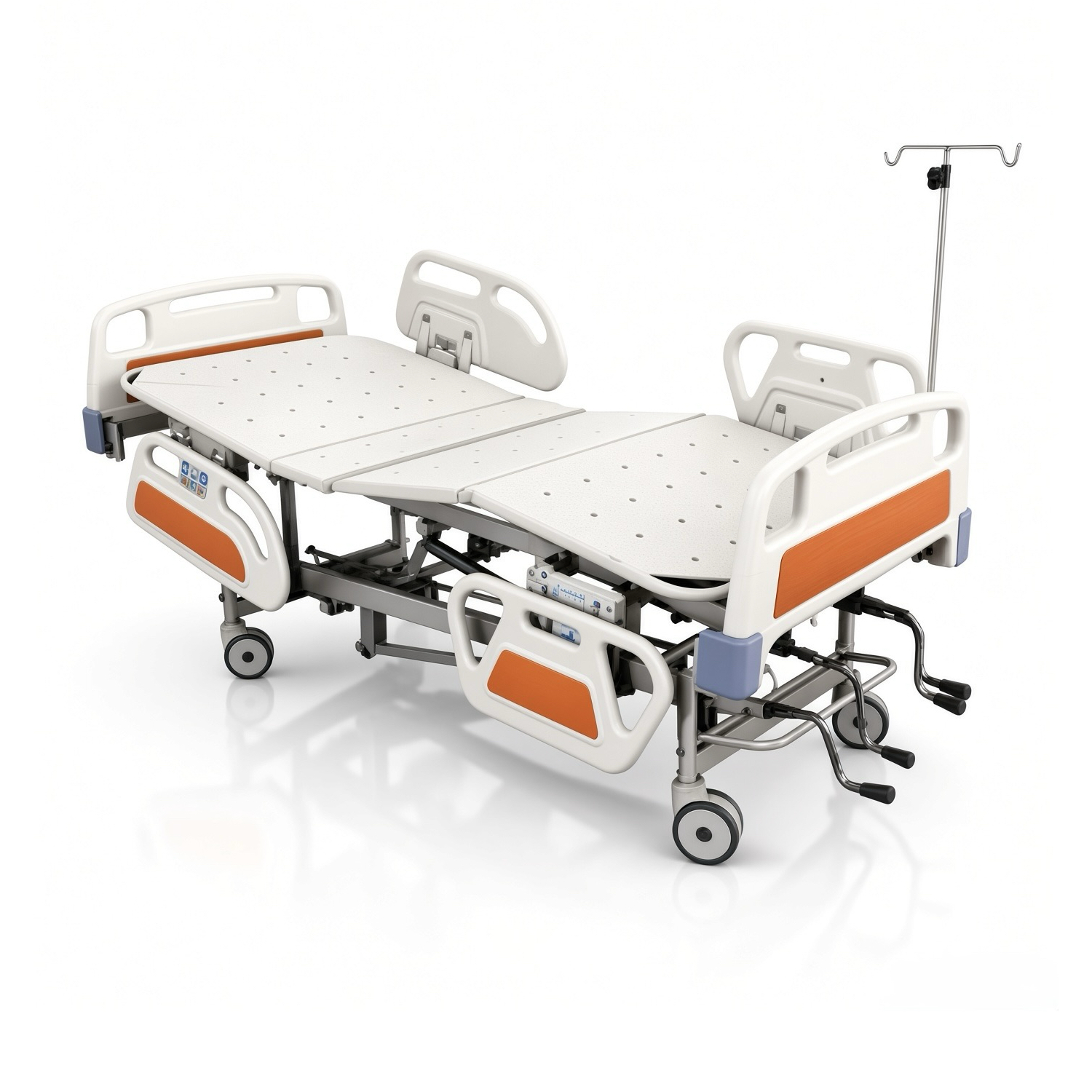
In some hospitals, that simplicity can be valuable. There may be fewer electronic components to troubleshoot, operation may remain possible during power interruptions, and maintenance teams may already be familiar with mechanical systems.
The trade-off is that frequent adjustments normally require greater staff involvement than powered positioning.
That is why I would not recommend eliminating mechanical ICU beds from consideration purely because electric equipment appears more sophisticated. The decision should follow workload, staffing, infrastructure and maintenance capability.
9. Consider Imaging and Bedside Equipment
Critical-care patients often have several other devices around them. The bed therefore needs to be considered as part of a larger clinical workspace.
Depending on the required configuration, procurement teams may need to examine IV-pole positions, oxygen-cylinder provisions, accessory mounting points and compatibility with bedside procedures.
Some ICU-bed designs may also offer an X-ray-translucent back section or provision for an imaging cassette. Where such a feature is required, hospitals should confirm exactly which section is radiolucent and what imaging workflow the bed is designed to support.
A statement such as “X-ray compatible” is not specific enough for a controlled procurement document.
10. Dimensions Matter Before the Bed Reaches the ICU
One of the simplest procurement mistakes is to focus on clinical functions without checking physical dimensions carefully.
Overall bed length and width affect doorway clearance, lift access, room planning, storage and the amount of working space available around the patient.
Hospitals should also distinguish between the overall bed size and the mattress or patient-support surface. These measurements are not automatically the same.
Before approving a large order, I would want the hospital team to verify the intended route from receiving area to ward, lift dimensions, door clearance and the final bed-space layout.
11. Cleaning and Infection-Control Practicality Should Be Evaluated Physically
Specifications can tell us whether a bed uses ABS, stainless steel, powder-coated mild steel or aluminium components. They do not always reveal how easy the complete structure is to clean in real use.
Look around joints, control housings, rails, deck sections, wheel assemblies and moving components. Ask how easily staff can reach surfaces during routine cleaning.
Material compatibility with the healthcare facility's approved cleaning procedures also matters. A hospital should follow the manufacturer's instructions for cleaning and maintenance rather than assuming that every surface tolerates every chemical.
12. Purchase Price Is Only One Part of ICU Bed Cost
An ICU bed can remain in service for many years, so its real cost extends beyond the purchase invoice.
Hospitals should consider servicing requirements, expected availability of spare parts, motors and actuators where applicable, control systems, castors, rails, panels and other components that may experience wear.
A sophisticated feature that becomes difficult to maintain can eventually become a liability rather than an advantage.
For large hospital projects, I would therefore give lifecycle support a formal place in the procurement evaluation rather than leaving it as an afterthought.
A Practical Way to Write an ICU Bed Specification
Instead of beginning a tender with a model name, I prefer beginning with functional requirements.
Define the intended care area. State the required positioning functions. Specify whether electric, hydraulic or mechanical adjustment is acceptable. Define the required height range, rail configuration, braking arrangement, mobility requirement, dimensions and necessary accessories.
If CPR controls, nurse controls, central braking, Trendelenburg positioning, imaging provisions or particular accessory locations are genuinely required, state them clearly.
This approach allows different beds to be compared against the hospital's needs instead of encouraging procurement teams to copy the specification of one particular product.
My View: The Best ICU Bed Is the One the Hospital Can Use Well
When hospital equipment is purchased, there is a natural tendency to equate a larger feature list with better value.
I think ICU beds demonstrate why that assumption can be misleading.
A good ICU bed should support the clinical environment without creating unnecessary complexity. Its positioning functions should correspond to actual patient-care needs. Staff should be able to operate it confidently. The braking and mobility system should suit the facility. Cleaning should be practical. Maintenance and spare-parts support should be realistic.
For some hospitals, that conclusion will lead to an advanced electric bed with multiple powered movements, nurse controls, CPR capability and central braking. For another healthcare facility, a more straightforward electric, hydraulic or mechanical configuration may be the more sensible long-term choice.
The important thing is that the decision is intentional.
Hospitals should not ask, “Which ICU bed has the most features?” They should ask, “Which functions will our patients and caregivers actually use, and can we support this bed reliably throughout its working life?”
That single change in the question can lead to much better procurement decisions.
Author disclosure: The author works in the medical-equipment manufacturing sector with IndoSurgicals Private Limited. Product photographs from IndoSurgicals are used in this article to illustrate different ICU-bed configurations. The selection principles discussed here are intended to apply broadly across manufacturers and are not a recommendation to purchase any particular model or brand.
For readers who want to examine examples of the different configurations discussed above, the current IndoSurgicals ICU bed range includes electric, hydraulic/mechanical and mechanical models with different positioning, rail and braking arrangements.
How did this opinion land?
Kumar Akhil Yadav
Director at IndoSurgicals Private Limited


Comments
Sign in to share your opinion on this article.
Be the first reader to contribute to this discussion.